
IB Digital Society Inquiry Project (IA) Examiner's Checklist for Assessing: Comprehensive DS IA Guide for Assessment & Evaluation (Jan 2026 updated guide)

Updated: Jan 19
INTRODUCTION
This comprehensive assessment guide is your complete resource for achieving excellence in the IB Diploma Programme Digital Society Internal Assessment (Inquiry Project). Designed for students, teachers, and educational professionals worldwide, this guide provides detailed criteria, practical checklists, and quality benchmarks for every aspect of the IA.
Developed from IB insights (May 2024, November 2024 and May 2025), this guide reflects actual examiner feedback and observed patterns in high-scoring work. It serves as both a roadmap during project creation and a thorough evaluation tool to ensure you meet IB excellence standards.
What Does Grade 7 Excellence Look Like?
To achieve a Grade 7 in Digital Society, you must demonstrate:
Conceptual Awareness: Deep insight into Digital Society concepts, content, and contexts
Critical Thinking: Well-structured, logical arguments supported by robust evidence
Precise Terminology: Accurate use of Digital Society-specific language throughout
Depth of Analysis: Sophisticated evaluation of evidence with multiple perspectives
Reflective Practice: Evidence of critical self-assessment and reflective thinking
Need a Quick Reference?
This comprehensive guide is detailed and thorough. If you need a rapid checklist for quick gap-checking or final submission review, visit:
HOW TO USE THIS CHECKLIST
For Students: Use this guide throughout your inquiry journey, from developing your inquiry question to final submission. Each criterion includes detailed checklists to help you self-assess and improve your work before submission.
For Teachers: This guide provides standardised assessment frameworks. Use the quick assessment matrices for efficient marking and the detailed checklists for comprehensive feedback.
RESEARCH METHODOLOGY FLEXIBILITY
Digital Society inquiries span diverse topics requiring different approaches. This checklist accommodates multiple research methodologies:
✓ User-focused studies (surveys, interviews, observations)
✓ System analysis (testing, performance evaluation, security audits)
✓ Policy/governance research (case studies, comparative analysis)
✓ Cultural/social impact (ethnography, content analysis)
✓ Technical investigations (code analysis, algorithm evaluation)
✓ Design thinking (prototyping, user testing)
KEY PRINCIPLE: Your methodology should:
1. Match your specific inquiry question
2. Generate original insights
3. Be clearly explained and justified
4. Meet ethical standards
5. Provide evidence for analysis
If your research approach differs from examples given, ensure you clearly justify why it's appropriate for your inquiry focus.
GRADE 7 STANDARD TEST
The Ultimate Question: "Would a professional in the field (academic researcher, industry expert, policy maker) consider this research credible, rigorous, and insightful?
If YES → You're on track for Grade 7
If NO → Review the gaps and strengthen your work
CRITERION A: INQUIRY FOCUS (3 marks)
Project element: Inquiry process document (~300 words)
OFFICIAL IB DP DIGITAL SOCIETY MARK BANDS for CRITERION A:
0: The work does not reach a standard described by the descriptors below.
1: The focus is limited and/or incomplete. The focus does not include all required elements and/or the real-world examples are not specific or relevant.
2: The focus is adequate. The focus includes an inquiry question and a partial explanation of its connection to specific, relevant real-world examples.
3: The focus is appropriate and targeted. The focus includes an inquiry question and a thorough explanation of its connection to a specific, relevant real-world examples.
To achieve a Grade 7 in Digital Society, you must demonstrate:
Conceptual Awareness: Show deep insight and understanding of Digital Society.
Critical Thinking: Provide well-structured, logical arguments supported by evidence.
Precise Use of Terminology: Use Digital Society-specific language accurately.
Depth of Analysis: Analyse and evaluate evidence while considering alternative perspectives.
Reflection: Show evidence of reflective thinking and critical self-assessment.
What is Criterion A assessing?
This criterion evaluates how well students establish their inquiry focus by:
Formulating a focused, analytical inquiry question
Connecting it to a specific, current real-world example
Demonstrating understanding of Digital Society's 3Cs framework
Criterion A Checklist
Inquiry Question Quality: Does the question:
Use appropriate command terms ("To what extent...", "How does...", "Why do...")?
Focus on a specific digital technology/system (not "technology in general")?
Target a specific context (education, healthcare, business, etc.)?
Require analysis and evaluation, not just description?
Allow for multiple perspectives and evidence-based analysis?
Avoid simple yes/no answers?
Enable meaningful, in-depth research?
Real-World Example: Is the example:
Specific and concrete with named organisations/systems?
Current and recent (within the last 4 years)?
Clearly relevant to the inquiry question?
Well-defined with specific details and data?
Properly cited with complete source information?
Substantial (more than just a brief mention)?
Involving specific digital systems rather than general technology?
Suitable for detailed analysis and evaluation?
Cited with source (reference not included in word count)?
Includes sufficient specific detail (not just a brief mention)?
Cited with source reference (not counted in word count)?
An actual occurrence, not hypothetical?
3Cs Connections: Has the student:
Referenced specific concept numbers from the guide (e.g., "Change 2.1")?
Referenced specific content areas with numbers (e.g., "AI-3.6.E")?
Referenced specific context numbers (e.g., "Human Knowledge-4.5A")?
Used Digital Society terminology accurately throughout?
Explained clearly how the inquiry connects to each of the 3Cs (Digital Society’s CONCEPT-CONTENT-CONTEXT?
Demonstrated deep conceptual understanding?
Applied appropriate Digital Society frameworks?
Connected to broader societal implications?
Technical Requirements: Has the student:
Cited all sources properly with complete information?
Used precise Digital Society vocabulary consistently?
Followed proper formatting guidelines?
Met word count requirements (~300 words for Criterion A)?
Included all required sections clearly?
Structured the document with clear organization?
Maintained academic tone throughout?
Criterion A Excellence Indicators: To achieve highest marks (Mark 3), ensure:
Deep conceptual awareness demonstrated throughout
Critical thinking evident in question formulation
Precise terminology used accurately
Clear analytical focus established
Evidence of reflection in connections made
Strong logical structure in explanation
Well-supported arguments for relevance
Quick Criterion A Assessment Matrix
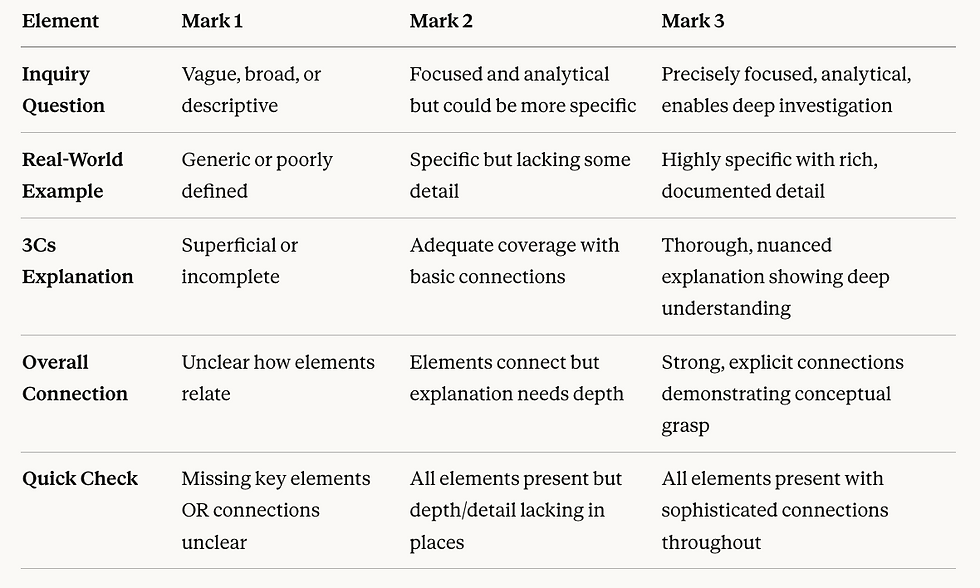
CRITERION B: CLAIMS AND PERSPECTIVES (6 marks)
Project element: Inquiry process document (~1200 words total)
OFFICIAL IB DP DIGITAL SOCIETY MARK BANDS for CRITERION B:
0: The work does not reach a standard described by the descriptors below.
1-2: The discussion of claims and perspectives is limited and primarily descriptive in nature. Fewer than three sources are discussed or there is no justification for their use in the inquiry.
3-4: There is a partial discussion of the claims and perspectives for each source that includes some justification for their usefulness in the inquiry, but this is not fully developed.
5-6: There is a thorough discussion of the claims and perspectives for each source that includes a clear justification for their usefulness in the inquiry.
To achieve a Grade 7 in Digital Society, you must demonstrate:
Conceptual Awareness: Show deep insight and understanding of Digital Society.
Critical Thinking: Provide well-structured, logical arguments supported by evidence.
Precise Use of Terminology: Use Digital Society-specific language accurately.
Depth of Analysis: Analyse and evaluate evidence while considering alternative perspectives.
Reflection: Show evidence of reflective thinking and critical self-assessment.
What is Criterion B assessing?
This criterion evaluates how well students:
Select and analyse high-quality, relevant sources for their inquiry
Critically discuss the claims and perspectives presented in each source
Evaluate the strengths and limitations of each source
Justify why each source is specifically useful for their inquiry
Demonstrate sophisticated research and source evaluation skills
CRITERION B CHECKLIST
Source Quality: Are the sources:
From peer-reviewed academic journals (Priority 1)?
From government/institutional reports or white papers (Priority 2)?
From reputable news sources with expert analysis (Priority 3)?
Published within the last 4 years (unless historically significant)?
Credible and authoritative in the field?
Representing different perspectives on the topic?
Directly relevant to your inquiry question?
Three distinct, high-quality sources minimum?
Reference & Context (Origin): For each source, has the student:
Provided complete bibliographic citation?
Clearly stated author credentials and expertise?
Identified publication date and context?
Assessed publisher reputation and credibility?
Identified the intended audience?
Described data collection or research methods?
REQUIRED STRUCTURE: Has the student, for each Source Included these FOUR Sections:
Section 1: Citation
Complete bibliographic citation in chosen format
Must match format used in Bibliography
Section 2: Claims and Perspectives
2-3 main arguments identified
Evidence supporting claims evaluated
What perspective(s) does source represent?
Reliability and credibility assessed
Underlying assumptions examined
Alternative viewpoints considered
Connected to inquiry question
Section 3: Credibility & Value
Author credentials/expertise stated
Publisher reputation assessed
Research methodology strengths
Purpose and objectives explained
Unique perspectives/insights highlighted
Specific data/evidence supporting inquiry
Section 4: Justification for Use
Specific role this source plays in inquiry
Why specifically relevant to inquiry question
Connection to 3Cs framework
How relates to other two sources
Contribution to overall analytical approach
Claims and Perspectives Analysis: For each source, has the student:
Identified the 2-3 main arguments or claims?
Evaluated the evidence supporting these claims?
Analysed what perspective(s) the source represents?
Assessed the reliability and credibility of claims?
Examined underlying assumptions or theoretical frameworks?
Considered alternative viewpoints or counterarguments?
Connected claims directly to the research question?
Moved beyond description to critical analysis?
Value and Limitations: For each source, has the student:
Explained the source's purpose and research objectives?
Identified specific data, statistics, or evidence that supports the inquiry?
Highlighted unique perspectives or insights offered?
Assessed methodological strengths?
Noted scope restrictions or sample size limitations?
Identified potential biases or conflicts of interest?
Acknowledged methodological weaknesses?
Considered funding sources (if relevant)?
Justification and Use: For each source, has the student explained:
The specific role this source plays in the inquiry? (Most important)
Why this source is specifically relevant to the inquiry question?
How it connects to your 3Cs framework (concepts, content, contexts)?
What strengths this source brings (data, methodology, perspective)?
How this source relates to the other two sources?
How the three sources work together (complement, contrast, or build upon each other)?
How sources support the overall analytical approach?
Across all sources, has the student:
Compared perspectives across the three sources?
Identified patterns, contradictions, or tensions?
Synthesised findings to build understanding?
Technical Requirements: Has the student:
Used proper bibliographic format consistently (MLA, APA, Chicago)?
Included complete citation information (author, title, date, publisher, DOI/URL)?
Avoided plagiarism and properly paraphrased?
Distinguished between summary and critical analysis?
Used Digital Society terminology appropriately?
Maintained academic tone throughout?
Structured analysis clearly for each source?
Met word count requirements (~400 words per source, ~1200 words total)?
Excellence Indicators: To achieve highest marks (5-6), ensure:
Deep critical analysis, not just description, of all claims and perspectives
Balanced representation of different perspectives across sources
Clear, compelling justification for source selection strategy
Strong synthesis connecting all three sources to the inquiry focus
Thorough, nuanced evaluation of methodology and limitations
Explicit links between sources and the inquiry question
Evidence of sophisticated source evaluation and research skills
Integration of Digital Society concepts and terminology
Consideration of how sources complement, contrast, or challenge each other
Quick Criterion B Assessment Matrix

CRITERION C: ANALYSIS AND EVALUATION (6 marks)
Project element: Presentation
OFFICIAL IB DP DIGITAL SOCIETY MARK BANDS for CRITERION C
0: The work does not reach a standard described by the descriptors below.
1-2: There is limited analysis and evaluation which is primarily descriptive in nature or of limited relevance to the inquiry focus
3-4: The student's analysis and evaluation of impacts and implications for people and communities is adequate, but this is not always sustained or well-supported
5-6: The student's analysis and evaluation of impacts and implications for people and communities is effective, sustained and well-supported by evidence
To achieve a Grade 7 in Digital Society, you must demonstrate:
Conceptual Awareness: Show deep insight and understanding of Digital Society.
Critical Thinking: Provide well-structured, logical arguments supported by evidence.
Precise Use of Terminology: Use Digital Society-specific language accurately.
Depth of Analysis: Analyse and evaluate evidence while considering alternative perspectives.
Reflection: Show evidence of reflective thinking and critical self-assessment.
What is Criterion C assessing? This criterion evaluates how well students:
Provide their own sustained and well-supported analysis throughout the presentation
Evaluate impacts and implications of digital systems on people and communities
Move beyond description to critical evaluation
Support analytical claims with robust evidence
Conclude with a direct answer to the inquiry question
Demonstrate depth and sophistication in their thinking
Connect findings to broader Digital Society themes
Key Focus: Quality of analysis and evaluation, not quantity of research. The research serves to enable deeper, more original analysis.
Critical Structure: Criterion C includes BOTH the analysis/evaluation AND the conclusion that answers the inquiry question. The conclusion must be clearly signposted within Criterion C.
CRITERION C vs D: UNDERSTANDING THE DIFFERENCE
CRITERION C (Analysis, Evaluation & Conclusion):
Analysis of impacts on people and communities
Evaluation of implications
CONCLUSION answering the inquiry question
Clear signposting when conclusion begins
CRITERION D (Emerging Trends & Future Developments):
Emerging trends (what's happening NOW, 0-2 years)
Future developments (what's COMING, 2-5+ years)
Further insights about these trends/developments
Clear signposting when this section begins
SIMPLE DISTINCTION:
C = Analyse the present + Conclude: What's happening? How are people affected? What's the answer to my question?
D = Look to the future: What trends are emerging? Where are things heading?
FLOW:
Analysis → Evaluation → [SIGNPOST] → Conclusion (all C) → [SIGNPOST] → Emerging Trends → Future (all D)
Conclusions that relate to analysis and evaluation relating to the Inquiry Question should be included in Criterion C."
CRITERION C CHECKLIST
Research & Evidence Base: Does the presentation include:
Multiple types of evidence (academic sources, case studies, data, expert opinions)?
Primary research if conducted (surveys, interviews with stakeholders)?
High-quality secondary sources analyzed critically?
Original insights that go beyond existing published research?
Properly documented and cited sources?
Ethical research practices if primary research conducted?
Clear methodology explanation for any data collection?
Note: While not required, analysis of original primary research (50+ survey respondents, 2-3 interviews) is commonly seen in presentations achieving marks 5-6, as it enables unique insights and deeper evaluation.
Data Collection Quality (if primary research conducted): Has the student:
Collected survey data from a substantial sample (50-100+ respondents for robust findings)?
Provided demographic breakdown of participants?
Conducted interviews with 2-3 relevant stakeholders?
Designed questions directly connected to the inquiry focus?
Generated insights that existing sources could not provide?
Explained methodology clearly and transparently?
Followed ethical research practices throughout?
Note: Larger sample sizes and multiple research methods are observed patterns in high-scoring presentations, as they enable more rigorous analysis.
Data Presentation & Visualisation: Has the student included:
Charts, graphs, or infographics for quantitative data?
Statistical analysis with specific percentages and numbers (not vague statements)?
Direct quotes from interviews or stakeholders?
Visual representation of key findings?
Professional-quality data visualisation?
Clear labelling and captions for all visuals?
Interview transcripts or detailed notes in appendices (if applicable)?
Core Analysis: Impacts on People and Communities: Has the student analysed IMPACTS on:
Individuals: How specific users/people are affected in concrete ways?
Communities: How groups, societies, or populations are affected?
Different demographics: Varying effects on different age groups, socioeconomic levels, geographic locations, etc.?
Behaviours and practices: What people do differently as a result?
Skills and capabilities: Abilities gained, lost, or transformed?
Social dynamics: How relationships, interactions, or social structures change?
Power structures: Who gains or loses influence, access, or control?
Economic effects: Financial implications for individuals and communities?
Cultural shifts: Changes in values, norms, traditions, or practices?
Evaluation of Implications: Has the student evaluated IMPLICATIONS including:
Short-term and long-term consequences of the digital system?
Intended and unintended effects on stakeholders?
Both benefits AND concerns/risks in a balanced way?
Ethical considerations and moral dimensions?
Policy implications for governance or regulation?
Future trajectories: Where is this heading? What might happen next?
Equity and justice issues: Who benefits? Who is harmed or excluded?
Evidence-based solutions or recommendations for identified problems?
Across the presentation, has the student:
Moved consistently beyond description to critical evaluation?
Considered multiple stakeholder perspectives?
Addressed complexity and nuance rather than oversimplifying?
Made connections to broader Digital Society themes and concepts?
Conclusion [ESSENTIAL - Part of Criterion C]:
Has the student clearly signposted the conclusion section and:
Made it obvious to the examiner that this is the conclusion?
Has the student provided a clear conclusion that:
Explicitly and directly answers the original inquiry question? (Most critical)
Synthesises all evidence presented in the analysis?
Connects back to the inquiry focus established in Criterion A?
Demonstrates clear progression from question → research → analysis → answer?
Communicates degree of certainty/uncertainty appropriately?
Acknowledges remaining questions or limitations?
Relates back to impacts on people and communities?
Evidence Integration & Synthesis: Has the student:
Integrated multiple source types together effectively?
Synthesised primary research (if conducted) with secondary sources?
Provided specific statistics and concrete examples rather than vague generalisations?
Referenced expert opinions with proper attribution?
Supported every major claim with evidence?
Acknowledged limitations in data or analysis where appropriate?
Demonstrated original thinking rather than just summarising sources?
Built arguments logically with clear reasoning?
Sustained Analytical Depth: Does the analysis demonstrate:
Sustained focus on inquiry question throughout (not wandering off-topic)?
Consistent analytical rigour from start to finish (not just in some sections)?
Movement from surface-level to deeper insights?
Critical thinking rather than accepting claims at face value?
Evaluation of WHY impacts matter and WHAT they mean?
Connection of specific findings to broader societal implications?
Recognition of trade-offs, tensions, and competing values?
Sophisticated understanding of digital systems and their effects?
Presentation Delivery & Technical Requirements: Has the student:
Stayed within the 10-minute time limit?
Structured the presentation logically and coherently?
Used visual aids effectively (not just reading slides)?
Demonstrated deep understanding and expertise in the topic?
Engaged with ideas authentically (not reading a script)?
Used appropriate Digital Society terminology precisely and accurately?
Maintained focus on the inquiry question throughout?
Connected analysis to the 3Cs framework (concepts, content, contexts)?
Prepared effectively for potential questions?
Excellence Indicators: To achieve highest marks (5-6), ensure:
Sustained analytical depth maintained throughout entire presentation (not just in sections)
Well-supported arguments with diverse, robust evidence at every major point
Balanced, nuanced evaluation of both benefits AND concerns
Multiple stakeholder perspectives demonstrating complexity and depth
Clear analysis of impacts on people AND communities specifically
Thoughtful evaluation of broader implications (ethical, social, policy, future)
Strong connections to Digital Society's 3Cs framework
Evidence-based recommendations or thoughtful conclusions
Professional presentation delivery showing mastery of topic
Original thinking and critical evaluation (not just summary of sources)
Recognition of complexity, trade-offs, and limitations in analysis
Quick Criterion C Assessment Matrix

CRITERION D: CONCLUSION (6 marks)
Project element: Presentation
OFFICIAL IB DP DIGITAL SOCIETY MARK BANDS for CRITERION D
0: The work does not reach a standard described by the descriptors below.
1-2: The conclusion is limited with little further insight into the inquiry focus. Emerging trends and future developments are referenced with limited or no discussion
3-4: The conclusion provides adequate further insight into the inquiry focus with a partial discussion of emerging trends and future developments
5-6: The conclusion provides effective and well-supported further insight into the inquiry focus with a thorough and substantiated discussion of emerging trends and future developments
To achieve a Grade 7 in Digital Society, you must demonstrate:
Conceptual Awareness: Show deep insight and understanding of Digital Society.
Critical Thinking: Provide well-structured, logical arguments supported by evidence.
Precise Use of Terminology: Use Digital Society-specific language accurately.
Depth of Analysis: Analyse and evaluate evidence while considering alternative perspectives.
Reflection: Show evidence of reflective thinking and critical self-assessment.
What is Criterion D assessing?: This criterion evaluates the conclusion section of the presentation, where students:
Demonstrate further insight and new understanding gained through the inquiry
Provide a direct, explicit answer to the inquiry question
Discuss emerging trends (current developments, 0-2 years)
Explore future developments (evidence-based predictions, 2-5+ years)
Consider implications from multiple stakeholder perspectives
Apply design thinking through evidence-based solutions (when appropriate)
CRITERION D CHECKLIST
Clear Signposting: Has the student:
Clearly signaled when Criterion D begins (visual slide, verbal transition)?
Used a title/subtitle indicating "Emerging Trends and Future Developments"?
Critical Note: The Emerging trends and future developments in Criterion D must follow the conclusion and should have a title where they begin.
Emerging Trends [What's Happening NOW: 0-2 years]: Has the student identified and discussed:
Current developments happening now (within last 1-2 years)?
Specific institutional or organisational examples of implementation?
Recent research findings or academic developments?
Pilot programs or trials with documented results?
Regulatory or policy developments currently shaping the field?
Technology advances currently in development or early deployment?
Social or cultural shifts related to the topic?
Credible sources cited for each trend?
Substantiation - evidence provided, not just assertions?
Future Developments [What's COMING NEXT: 2-5+ years]: Are the student's predictions:
Based on current evidence and logical extrapolation (not pure speculation)?
Supported by credible research or expert opinion from the field?
Connected to emerging trends identified above?
Realistic and achievable within reasonable timeframes?
Considering multiple possible scenarios or trajectories?
Addressing potential challenges, obstacles, or barriers?
Relevant to specific inquiry focus?
Demonstrating understanding of broader implications for society?
Considering impacts on different stakeholder groups?
Substantiated with specific evidence, not just opinions?
Critical Note: Future developments are evidence-based predictions grounded in current trends and expert analysis, not wishful thinking or science fiction.
Further Insight [Demonstrating Understanding]: Has the student demonstrated:
Insights about where the digital system is heading?
Understanding of how current trends will likely evolve?
Recognition of what's uncertain vs. what's probable?
Connections between trends and broader societal changes?
Thoughtful analysis of implications of future developments?
Critical Note: "Further insight" in Criterion D means insights about trends and future developments, not the main conclusions about the inquiry question (which belong in Criterion C).
Multiple Stakeholder Perspectives [Essential Digital Society Skill]: Throughout the conclusion, has the student:
Considered implications from multiple stakeholder viewpoints?
Addressed how different groups are affected differently?
Included perspectives from diverse stakeholders (users, communities, developers, policymakers)?
Acknowledged tensions or trade-offs between interests?
Demonstrated understanding of diverse needs?
Solutions and Design Thinking [Observed Pattern in High-Scoring Work]: Has the student provided:
Evidence-based solutions addressing identified problems?
Stakeholder-specific recommendations (individuals, communities, developers, policymakers)?
Implementation strategies for realistic application?
Evaluation methods for measuring success?
Consideration of feasibility and obstacles?
Connection to design thinking principles?
Critical Note: While not explicitly required, analysis of exemplar presentations achieving marks 5-6 shows evidence-based solutions and design thinking approaches are common characteristics of top-scoring conclusions.
Evidence and Substantiation: Are conclusions and predictions:
Supported by primary research findings (if conducted)?
Backed by credible secondary sources (academic, expert, institutional)?
Connected to specific real-world examples?
Acknowledging uncertainty appropriately?
Avoiding overgeneralization from limited data?
Considering alternative explanations?
Demonstrating sophisticated understanding of complexity?
Using precise Digital Society terminology?
Presentation Delivery for Conclusion Section: Has the student:
Clearly signaled when Criterion D section begins?
Maintained focus on trends and future (not repeating Criterion C analysis)?
Used visual aids effectively?
Delivered with confidence demonstrating expertise?
Connected to 3Cs framework (concepts, content, contexts)?
Allocated appropriate time (2-2.5 minutes recommended)?
Stayed within overall 10-minute presentation limit?
Excellence Indicators: To achieve highest marks (5-6), ensure:
Core Requirements:
Clear, explicit answer to inquiry question
Effective further insight demonstrating genuine new understanding
Thorough discussion of emerging trends with specific current examples
Substantiated future developments with credible evidence
Well-supported throughout - every claim backed by evidence
Quick Criterion D Assessment Matrix

CRITERION E: COMMUNICATION (3 marks)
Project element: Presentation
OFFICIAL IB DP DIGITAL SOCIETY MARK BANDS for CRITERION
0: The work does not reach a standard described by the descriptors below.
1: Communication is limited. The presentation's organisation and use of media are limited and do not support understanding
2: Communication is adequate. The presentation is adequately organised and the use of media is at times coherent but this is not sustained or only partially effective in supporting understanding
3: Communication is effective. The presentation is well-organised and coherently uses media to support understanding
To achieve a Grade 7 in Digital Society, you must demonstrate:
Conceptual Awareness: Show deep insight and understanding of Digital Society.
Critical Thinking: Provide well-structured, logical arguments supported by evidence.
Precise Use of Terminology: Use Digital Society-specific language accurately.
Depth of Analysis: Analyse and evaluate evidence while considering alternative perspectives.
Reflection: Show evidence of reflective thinking and critical self-assessment.
What is Criterion E assessing? This criterion evaluates how effectively students communicate their inquiry through:
Organisation: Logical structure, clear flow, effective transitions between ideas
Media Use: Coherent integration of visuals, audio, video, and digital tools that support understanding
Documentation: Complete, accurate citation and bibliography of all sources, media, and tools used
Key Focus: Communication quality - how well the presentation's structure and media work together to support audience understanding of the inquiry.
CRITERION E CHECKLIST
Presentation Organisation: Is the presentation:
Well-structured with clear introduction establishing inquiry focus?
Following logical flow from question → analysis → conclusion?
Using smooth transitions between sections and ideas?
Maintaining focus on inquiry throughout (not wandering off-topic)?
Signposting clearly (audience knows where they are in presentation)?
Concluding with reinforcement of key insights?
Demonstrating confident subject knowledge through delivery?
Engaging audience with compelling, clear content?
Note: Organisation assessed based on whether structure supports understanding of the inquiry.
PRESENTATION STRUCTURE: Did the student follow this structure:
(SIGNPOTS) Introduction- State inquiry question clearly
(SIGNPOTS) Description of Digital System(s) - Explain the technology and its use
(SIGNPOTS) Analysis and Evaluation - Impacts and implications on stakeholders (Criterion C)
(SIGNPOTS) Conclusion - Answer to inquiry question (Criterion C)
(SIGNPOTS) Emerging Trends and Future Developments - What's happening now and coming next (Criterion D)
Media and Digital Tools: Does the presentation use media that:
Supports understanding (not just decoration or filler)?
Is coherently integrated (purposeful placement, not random)?
Enhances rather than distracts from content?
Shows professional quality (clear images, readable text, audible audio)?
Demonstrates appropriate variety (when helpful for understanding)?
Considers accessibility (readable fonts, sufficient contrast, clear audio)?
Uses visual aids effectively (graphs, charts, images that clarify concepts)?
Integrates images/audio/video effectively?
Shows mastery of digital communication tools?
Uses subtitles (closed captions) THROUGHOUT presentation?
Note: Examiners' mother tongue may not be English
Citations and Attribution: Has the student:
Cited sources at point of use during presentation (Author + Year format)?
Included visual cues for images and media used?
Provided brief but clear citation information on slides?
Maintained consistent citation format throughout?
Acknowledged all borrowed content clearly?
Distinguished student's original work from others' contributions?
Referenced interview sources appropriately?
Complete Bibliography - List 1: Ideas and Content: Does it include complete citations for:
All secondary sources (academic journals, books, reports, websites)
All primary research (interviews, surveys) with full details
AI Tools: Include prompts used and dates: Format example: "ChatGPT (OpenAI). Prompt: '[exact prompt]'. Accessed: [date]"
Complete Bibliography - List 2: Media: Does it include complete citations for:
All images?
All video clips?
All audio clips ?
All graphics/infographics?
All data visualisations?
Complete Bibliography - List 3: Digital Tools: Does it include:
All software/applications used to CREATE presentation?
Presentation platforms (PowerPoint, Prezi, Google Slides, etc.)?
Video/audio editing tools?
Data visualisation tools (Canva, Tableau, Excel, etc.)?
Survey tools (Google Forms, Qualtrics, etc.)?
Presentation Delivery: Has the student:
Stayed within 10-minute limit? (Examiners stop watching after 10 minutes)
Paced presentation appropriately (not rushed or dragging)?
Spoken clearly and audibly (if presenting live)?
Used appropriate academic tone and Digital Society terminology?
Demonstrated confidence and expertise?
Supporting Materials [Not assessed under Criterion E but observed in high-scoring work]: Has the student included appropriate appendices:
Complete interview transcripts?
Survey questions and raw data?
Additional charts and graphs not included in presentation?
Detailed methodology explanations?
Screen references directing to full bibliography?
Well-organized and clearly labeled materials?
Note: Appendices support primary research claims (assessed under Criteria C and D) but are not directly assessed as part of communication quality.
PRIMARY RESEARCH APPENDICES: When interviews are conducted:
Full transcript with appropriate heading in appendix
Context provided (who, when, where, why this person)
Survey instrument (the actual questions asked)
Survey details: methodology, when conducted, where, how distributed
Survey results: complete data with demographic breakdown
Analysis explaining what the data shows
Excellence Indicators: To achieve the highest mark (Mark 3), ensure:
Organization:
Clear, logical structure evident from beginning to end
Smooth transitions creating coherent narrative flow
Audience can easily follow progression of ideas
Professional delivery demonstrating confidence and expertise
Media Use:
Every media element serves a purpose in supporting understanding
Coherent integration throughout (not random or forced)
Professional quality visuals that are clear and accessible
Creative and purposeful use of digital tools
Accessibility considerations (readable fonts, contrast, clear audio)
Documentation:
Complete three bibliographies as required by IB
Consistent citation format throughout
All sources, media, and tools properly documented
Professional presentation of citations and references
Overall Communication:
Presentation consistently effective in supporting understanding
Structure and media work together seamlessly
Content communicated clearly and professionally
Stays within 10-minute time limit with all content included
Quick Criterion E Assessment Matrix

FINAL QUALITY ASSURANCE CHECKLIST
Before Final Submission - The Ultimate Check:
Academic Rigour
Would a university professor find this research credible?
Have I contributed original insights through primary research?
Are all claims supported by specific, verifiable evidence?
Have I maintained objectivity while developing insights?
Digital Society Integration
Are Digital Society concepts evident throughout my analysis?
Have I used appropriate terminology accurately?
Do I demonstrate deep understanding of the subject?
Are connections to broader societal themes clear?
Research Quality
Substantial primary research (50-100+ survey respondents, 2-3 interviews)?
Recent, high-quality secondary sources (within last 4 years)?
Balanced perspectives addressing multiple stakeholder viewpoints?
Evidence-based conclusions and future predictions?
Professional Standards
Complete, accurate citations throughout presentation and bibliography (three lists)?
Professional presentation quality (subtitles, clear audio/visuals, coherent media)?
Comprehensive supporting materials in appendices?
Ethical research practices maintained throughout?
Critical Structure Check
IPD: Two separate sections (A & B), ≤1500 words, no conclusion?
Presentation: Clear signposting: Analysis → [Conclusion] → [Trends/Future]
Time/Length: ≤10 minutes presentation?
Integration: A & B content woven naturally (NOT word-for-word repetition)?
If you can confidently check ALL boxes above, your Inquiry Project meets IB excellence standards.
GRADE PREDICTION GUIDE
Grade 7 (18-20 marks total):
Demonstrates university-level research quality
Includes substantial primary research with professional analysis
Shows deep Digital Society conceptual understanding
Provides evidence-based insights and future predictions
Maintains professional academic standards throughout
Grade 6 (15-17 marks total):
Good research quality with some original elements
Clear understanding of Digital Society concepts
Some analytical depth with adequate evidence
Generally well-organized and presented
Grade 5 (12-14 marks total):
Adequate research with limited original investigation
Basic understanding of concepts with some analysis
Some organizational and presentation issues
Limited depth of insight or future consideration
If you're consistently hitting "Excellence Indicators" across all criteria, you're on track for Grade 7 performance.


Comments